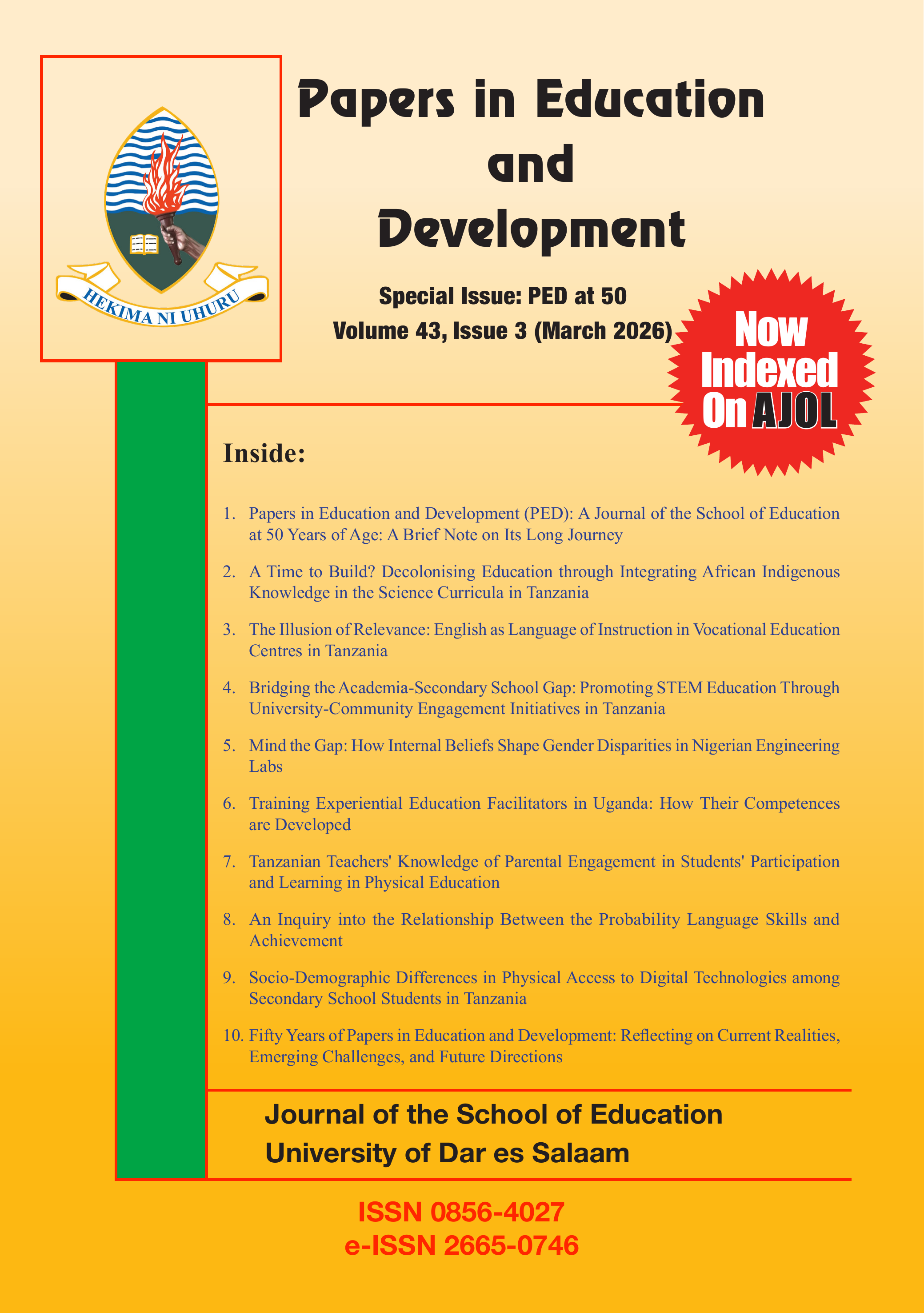
The Illusion of relevance: English as language of instruction in vocational education rentres in Tanzania
DOI:
https://doi.org/10.56279/ped.v43.special.i3.3Keywords:
vocational education and training, foreign language, English, Tanzania, linguistic imperialismAbstract
This paper reviews Tanzanian key policy documents, namely, Education for Self-Reliance (1967), the Education and Training Policy, the Technical Education and Training Policy (1996), and the Tracer Study Report for 2010–2015 VET Graduates (2019), to assess the suitability of English as a medium of instruction in Vocational Education and Training centres. Linguistic imperialism theory is used to examine whether using a foreign language supports effective skills acquisition. Findings indicate that cognitive skills are effectively developed when instruction occurs in a familiar language. Consequently, the intended benefits of vocational education are undermined by language barriers. The paper recommends adopting Kiswahili to achieve vocational education objectives.
References
Abdala, J. (2024). Perspectives and practices on using Swahili to teach and learn English in Tanzania's secondary schools. International Journal of Multilingualism, 22(2), 358–378. https://doi.org/10.1080/14790718.2024.2312887
Abdala, J. (2025). Reimagining language use in classrooms: Pre-service teachers' beliefs and practices in translanguaging pedagogy in Tanzanian secondary education. International Journal of Multilingualism. https://doi.org/10.1080/14790718.2025.2601275
Abdulatief, S., & McKinney, C. (2025). Working with teachers to disrupt Anglonormativity: A reflective account from the South. Language Awareness, 34(3), 614–635. https://doi.org/10.1080/09658416.2025.2555955
Adamson, L. (2020). Language of instruction: A question of disconnected capabilities. Comparative Education. https://doi.org/10.1080/03050068.2020.1812236
Amani, J. (2021). Access to and participation in basic education in Tanzania: A decade of key achievements and challenges. SN Social Sciences, 1(239), 1–21. https://doi.org/10.1007/s43545-021-00242-2
Andersen, M. J. W. (2024). Vocational teachers as policy actors: "Multilingualism as a resource" in Norwegian vocational education. Apples: Journal of Applied Language Studies, 18(1), 135–157. https://doi.org/10.47862/apples.136338
Babaci-Wilhite, Z. (2013). Local languages of instruction as a right in education for sustainable development in Africa. Sustainability, 5(5), 1994–2017. https://doi.org/10.3390/su5051994
Beach, D. N. (1994). A Zimbabwean past: Shona dynastic histories and oral traditions. Baobab Books.
Beiler, I. R. (2022). Anglonormativity in Norwegian language education policy and in the education trajectories of immigrant adolescents. Language Policy, 22, 95–117. https://doi.org/10.1007/s10993-022-09632-5
Boahen, A. A. (1975). Ghana: Evolution and change in the nineteenth and twentieth centuries. Longman.
Braun, V., & Clarke, V. (2022). Conceptual and design thinking for thematic analysis. Qualitative Psychology, 9(1), 3–26. https://doi.org/10.1037/qup0000196
Brock-Utne, B. (2007a). Language of instruction and student performance: New insights from research in Tanzania and South Africa. International Review of Education, 53(5–6), 509–530.
Brock-Utne, B. (2007b). Learning through a familiar language versus learning through a foreign language: A look into some secondary school classrooms in Tanzania. International Journal of Educational Development, 27(5), 487–498. https://doi.org/10.1016/j.ijedudev.2006.10.004
Brock-Utne, B. (2010). Research and policy on the language of instruction issue in Africa. International Journal of Educational Development, 30(6), 636–645. https://doi.org/10.1016/j.ijedudev.2010.03.004
Brock-Utne, B. (2012). Language and inequality: Global challenges to education. Compare: A Journal of Comparative and International Education, 42(5), 773–793. https://doi.org/10.1080/03057925.2012.706453
Copland, F., Garton, S., & Mann, S. (Eds.). (2016). LETs and NESTs: Voices, views and vignettes. British Council.
Cummins, J. (2000). Language, power and pedagogy: Bilingual children in the crossfire. Multilingual Matters.
Diop, C. A. (1987). Civilisation or barbarism: An authentic anthropology. Lawrence Hill Books.
Dettmann, E., & Günther, J. (2013). Subsidised vocational training: Stepping stone or trap? Assessing empirical effects using matching techniques. Swiss Journal of Economics and Statistics, 149(4), 405–443.
Ellis, C. A. (2016). How language, culture and emotions shape the mind (Unpublished doctoral dissertation). Bangor University.
Fussy, D. S., & Iddy, H. (2024). Harnessing the potential of translanguaging in Tanzanian secondary education. Qualitative Research Journal. https://doi.org/10.1108/QRJ-02-2024-0020
Hameso, S. Y. (2001). The language of education in Africa: The key issues. Language, Culture and Curriculum, 10(1), 1–13.
Kawonga, G., & Maliva, W. (2018). East African development: Language as a forgotten factor. In P. Cichocki & M. Zabek (Eds.), Development in East Africa: Cultural shifts in East Africa (Vol. 3). University of Warsaw.
Kimambo, I. N. (1969). A political history of the Pare of Tanzania, c. 1500–1900. East African Publishing House.
King, K. (1993). Technical and vocational education and training in an international context. The Vocational Aspect of Education, 45(3), 201–216. https://doi.org/10.1080/0305787930450302
Kisumbe, L. A., Yusuph, M. L., & Nyabakora, W. I. (2025). Impact of language of instruction on academic performance: A bibliometric review. Journal of Research Innovation and Implications in Education, 9(2), 53–71. https://doi.org/10.59765/bgr8492
Klassen, J. (2024). International organisations in vocational education and training: A literature review. Journal of Vocational Education and Training. https://doi.org/10.1080/13636820.2024.2320895
Komba, S. (2012). The predictive validity of the communication skills examination on students' overall academic performance at the Sokoine University of Agriculture (Unpublished doctoral dissertation). University of Dar es Salaam.
Krashen, S. D. (1985). The input hypothesis: Issues and implications. Longman.
Li, J., & Pilz, M. (2023). International transfer of vocational education and training: A literature review. Journal of Vocational Education and Training, 75(2), 185–218. https://doi.org/10.1080/13636820.2020.1847566
Maliva, W. (2024). English subject oral assessment in Tanzania secondary schools: Teachers' understanding, classroom practices and challenges (Unpublished doctoral dissertation). University of Dar es Salaam.
Maro, W. (2023). Stakeholders' perceptions of English as a medium of instruction in the acquisition of vocational skills in vocational training centres in Morogoro, Tanzania. Rwandan Journal of Education, 6(2), 251–265.
Masala, U. (2021). Teachers' perceptions on the use of translanguaging pedagogical practices in improving English language proficiency in Tanzania secondary schools (Unpublished MEDLED dissertation). University of Dar es Salaam.
Masqueda, E., & Maldonado, S. (2013). The effects of English language proficiency and curricular pathways: Latina/os' mathematics achievement in secondary schools. Equity & Excellence in Education, 46(2), 202–219. https://doi.org/10.1080/10665684.2013.780647
Mgaiwa, S. J. (2021). Fostering graduate employability: Rethinking Tanzania's university practices. SAGE Open, 1–14. https://doi.org/10.1177/21582440211006709
Nakamura, P., Molotsky, A., Zarzur, R. C., Ranjit, V., Haddad, Y., & DeHoop, D. (2023). Language of instruction in schools in low- and middle-income countries: A systematic review. Campbell Systematic Reviews. https://doi.org/10.1002/cl2.1351
Palmatier, R. W., Houston, M. B., & Hulland, J. (2018). Review articles: Purpose, process, and structure. Journal of the Academy of Marketing Science, 46, 1–5. https://doi.org/10.1007/s11747-017-0563-4
Pankhurst, R. (1968). Economic history of Ethiopia, 1800–1935. Addis Ababa University Press.
Pinxteren, B. V. (2022). Language of instruction in education in Africa: How new questions help generate new answers. International Journal of Educational Development, 88, 1–6. https://doi.org/10.1016/j.ijedudev.2021.102524
Phillipson, R. (2012). Linguistic imperialism. Oxford University Press.
Phillipson, R. (2016). Native speakers in linguistic imperialism. Journal for Critical Education Policy Studies, 14(3), 80–96.
Qorro, M. (1999). A qualitative study on the teaching and learning of writing in English in Tanzania secondary schools in relation to the writing requirements of tertiary education (Unpublished doctoral dissertation). University of Dar es Salaam.
Qorro, M. (2012). Investing in English language from the early grades in Tanzania primary schools: Implications for the proposed education and training policy. In M. Qorro, Z. Desai, & B. Brock-Utne (Eds.), Language of instruction: A key to understanding what the teacher is saying (pp. 56–74). LOITASA.
Qorro, M., Desai, Z., & Brock-Utne, B. (2012). Language of instruction: A key to understanding what the teacher is saying. LOITASA.
Qorro, M. A. S. (2013). Language of instruction in Tanzania: Why research findings are not heeded? International Review of Education, 59(1). https://doi.org/10.1007/s11159-013-9329-5
Shi, Y., & Bangpan, M. (2022). Young people's participation experiences of technical and vocational education and training interventions in low- and middle-income countries: A systematic review of qualitative evidence. Empirical Research in Vocational Education and Training, 14(8). https://doi.org/10.1186/s40461-022-00136-4
Snyder, H. (2019). Literature review as a research methodology: An overview and guidelines. Journal of Business Research, 104, 333–339. https://doi.org/10.1016/j.jbusres.2019.07.039
UNESCO. (1997). The teaching of non-mother tongues: An educational psychology-based approach to the educational context in multilingual African countries. UNESCO.
United Republic of Tanzania. (1967). Education for self-reliance. Government Printer.
United Republic of Tanzania. (1984). The education system in Tanzania towards the year 2000. Ministry of Education and Culture.
United Republic of Tanzania. (2020). Pre-primary, primary, secondary, adult and non-formal education statistics. President's Office – Regional Administration and Local Government.
United Republic of Tanzania. (2023). Education and training policy of 2014 (2023 edition). Ministry of Education, Science and Technology.
Vocational Education and Training Authority. (2019). Tracer study report for 2010–2015 vocational education and training graduates. VETA.
Vuzo, M. (2010). Exclusion through language: A reflection on classroom discourse in Tanzanian secondary schools. Papers in Education and Development, 29, 14–36.
Vuzo, M. (2012). Students' writing expertise in English and Kiswahili and implications for learning and performance in Tanzania secondary schools. Journal of Adult Education, 19, 98–120.
Wilson, J., & Komba, S. C. (2012). The link between English language proficiency and performance: A pedagogical perspective in Tanzania secondary schools. World Journal of English Language, 2(4), 1–10. https://doi.org/10.5430/wjel.v2n4p1
Downloads
Published
How to Cite
Issue
Section
License
Copyright (c) 2026 Papers in Education and Development

This work is licensed under a Creative Commons Attribution 4.0 International License.
This License permits use, sharing, adaptation, distribution, and reproduction in any medium or format, provided appropriate credit is given to the original author(s) and source.