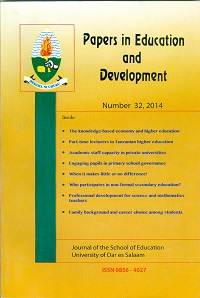
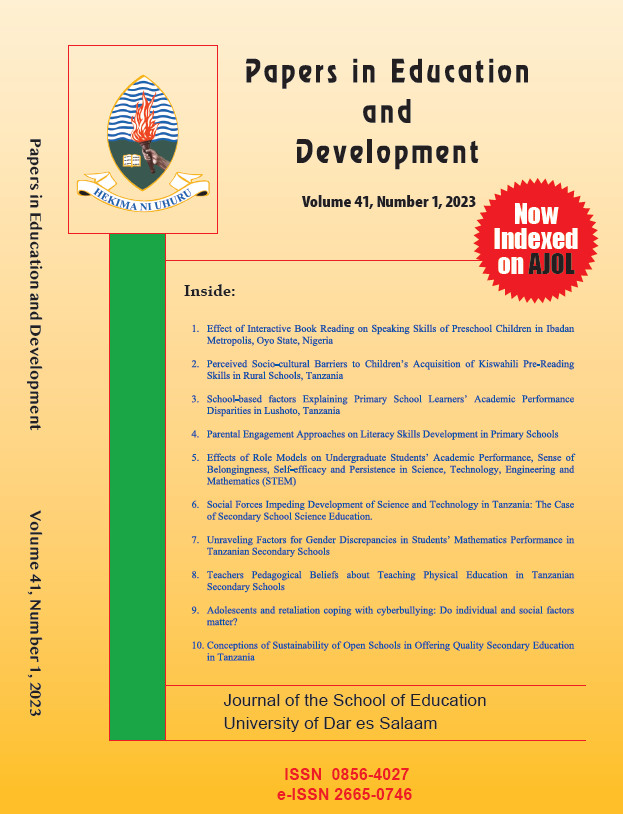
Perceived Socio-cultural Barriers to Children ' s Acquisition of Kiswahili Pre-Reading Skills in Rural Pre-primary Schools in Tanzania
Abstract
This paper explores socio-cultural barriers to children ' s acquisition
of Kiswahili pre-reading skills in rural public €“pre-primary schools in
Tanzania. Purposive sampling was used to obtain 48 pre-primary school
teachers, head teachers and parents. Data were collected through semistructured
interview and focus group discussion methods. Thematic analysis
was utilised in data analysis using NVivo-12 software for qualitative
and non-structured data. The findings revealed that mother-tongue
interference, limited parent-teacher collaboration and community beliefs
about children ' s education were the perceived socio-cultural barriers to
children ' s acquisition of Kiswahili pre-reading skills. The paper concludes
that children ' s acquisition of Kiswahili pre-reading skills was hampered
by the presence of various socio-cultural barriers. The paper recommends
that pre-primary school learning environments in rural areas should be
improved for children ' s successful acquisition of pre-reading skills.
Keywords: early childhood education, Kiswahili language, marginalised
schools, reading acquisition, socio-cultural barriers
Downloads
Published
How to Cite
Issue
Section
License
This License permits use, sharing, adaptation, distribution, and reproduction in any medium or format, provided appropriate credit is given to the original author(s) and source.