
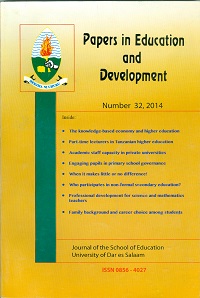
The Effect of the Knowledge-based Economy on Higher Education Practices in Tanzania
Papers in Education and Development
##common.published##: March 18, 2018
557
Article Views
All time
276
Downloads
All time
0
Citations
Source: OpenAlex
Activity (views + downloads) over time
Citations by year
No citation data available yet.
Abstract
Since the 1990s, multilateral organisations have been claiming that successful countries in the world are knowledge-based economies (KBE). Low-income countries were therefore challenged to reform their higher education policies so as to meet KBE requirements. It was asserted that through building KBE, low-income countries could leapfrog industrial development, thereby becoming globally competitive. Meanwhile, critics argue that KBE does not enable countries to prosper. Based on such arguments, a study was undertaken to examine how the urge to construct a KBE has influenced higher education in Tanzania. The findings suggest that efforts to construct a KBE through higher education in the country have been responsible for the erection of university structures which correspond to neo-liberalism. This paper argues that Tanzania ' s case gives evidence that the use of higher education to construct a KBE is a way through which higher education is tuned to aid the process of capitalist globalisation. Key words: Higher education, Knowledge-Based Economy, Discourse, Neo-liberalism, Tanzania