About the Journal
Overview
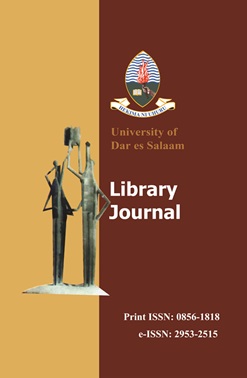
The University of Dar es Salaam Library Journal (UDSMLJ) is an international journal that was established in 1989 by the Information Studies unit of the University of Dar es Salaam. The journal aims to disseminate knowledge produced through research by library and information professionals. Since its establishment, the journal has maintained a positive track record for consistently publishing issues twice in June and December each year. The journal has two identifiers; ISSN, 0856-1818 for print and eISSN, 2953-2515 for online.
Focus and Scope
UDSMLJ is an interdisciplinary academic journal that publishes scholarly articles on all aspects of library, information science, and related fields of study. These include the organisation of knowledge, information dissemination , scholarly communication, knowledge management, information technology and its application in libraries, management of library and information services, information seeking behaviour, records and archives management, information literacy, information retrieval, reference services, and information Systems. The journal is published twice per year, that is, in June and December.
Peer Review Process
UDSMLJ editorial and peer review processes involve meticulous and transparent processes. Editorial and peer review processes include different stages where different individuals participate in the processes. These stages are manuscript submission, preliminary editorial screening, Peer review, and editorial decision.
Manuscript Submission
All manuscripts are submitted by corresponding authors through Open Journal System (OJS) platform. The submitted manuscripts will automatically be assigned a manuscript ID number for reference or tracking purposes.
Preliminary Editorial Screening
In the preliminary editorial screening, members of the editorial committee review the submissions, including the cover letters, cover pages, and main documents, to ascertain whether the manuscripts have met minimum requirements for peer review. Specifically, the initial editorial screening establishes if the manuscripts fall within the journal's aims and scope. In situations where the submitted manuscript does not fall within the journal’s readership scope, the manuscripts may be referred to another journal or rejected.
Peer Review
After passing the initial editorial screening stage, manuscripts are sent to the reviewers for double-blind review. The review process is rigorous and anonymous, where two to three anonymous reviewers evaluate the quality and credibility of the manuscripts before giving verdicts. The reviewers will evaluate the papers and submit their reports to the editor. The peer review is done by researchers and scholars who are experts in library and information science and related disciplines. The reviewers’ verdict will essentially fall under one of five recommendations: acceptance without any changes (this is a rare case); acceptance with minor revisions; acceptance with major revisions; resubmission and resending to the reviewers; or rejection of the manuscripts. Reviewers who agree to review the manuscripts are required to provide credible review reports that will improve the quality and readability of the manuscripts and maintain professionalism. Reviewers are expected to submit their review reports within two weeks from the date of acceptance. The Chief Editor of the UDSMLJ has the final say on the acceptance or rejection of the manuscripts.
Revision
When decisions on the manuscripts involve minor or major revisions, authors of the manuscripts will be required to revise the articles within a specified time, as indicated by the Editor or Assistant Editor. When decisions on the manuscripts direct authors to “resubmit” their manuscripts, editors will resend the manuscripts to reviewers to review and check if the comments provided have been addressed as directed.
Production
Once all editorial processes have been completed, the manuscripts will be sent to the journal administrator, who is in charge of publication on the online version and production of the print version. Prior to the publication and production, the manuscripts will undergo typesetting, formatting, and creative design.
Open Access Policy
This journal provides immediate open access to its content on the principle that makes research freely available to the public, supporting a greater global exchange of knowledge.
Compliance with Publication Ethics
The University of Dar es Salaam Library Journal (UDSMLJ) is committed to upholding the highest standards of publication ethics. All authors are expected to submit only original works that have not been previously published and are not under consideration elsewhere. To safeguard the academic integrity of the journal, all submitted manuscripts are checked using plagiarism and AI detection software to identify copied and pasted information. Manuscripts found to contain plagiarized content or that violate publication ethics will be rejected outright. If such violations are discovered after publication, UDSMLJ reserves the right to retract the article. Authors must ensure they have obtained appropriate permissions to reproduce any material not owned by them, and proper acknowledgements must be included in both print and electronic formats. UDSMLJ takes publication misconduct seriously and follows international guidelines to prevent and address issues such as data fabrication, duplicate publication, and unethical research practices.