
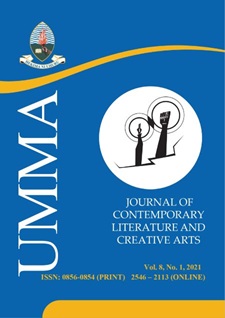
Intertextual Borrowings in Ngugi wa Thiong’o’s 'Petals of Blood'
Umma Journal of Contemporary Literature and Creative Arts
##common.published##: June 27, 2024
133
Article Views
All time
71
Downloads
All time
0
Citations
Source: OpenAlex
Activity (views + downloads) over time
Citations by year
No citation data available yet.
Abstract
In every writing, literary and non-literary, no text exists as a complete isolate and complete authorial innovation. It manifests and results from multiple borrowings, conscious and otherwise, from other texts. Following Kristeva (1986), Genette (1997) and William (2010), this study analysed Ngugi wa Thiong’o’s novel, Petals of Blood, to uncover differing extents of textual borrowing in the form of reference, quotation, parody, borrowing, allusion and translation. The study used document review and textual analysis to generate the data that was then subjected to content analysis register occurrences of different forms of intertextuality. Data analysis and interpretation entailed placing these occurrences into themes, establishing frequencies, and computing percentages. The resultant data were summarised and presented in tables and figures, coupled with evidential excerpts gleaned from the text. Borrowing emerged as the most predominant intertextual element, accounting for more than one-third of all intertextualities in Ngugi’s novel. In second came parody and allusion in that order. The other three forms of intertextuality—quotation, reference and translation—are comparably less pronounced in the novel. Conclusively, Ngugi's intertextuality subscribes to the spirit of Africanizing the English as a literary medium in the mould of what terms decolonize the mind of an African writer. Keywords: Africanizing English, borrowing, intertextuality, literary language https://dx.doi.org/10.56279/ummaj.v11i1.4